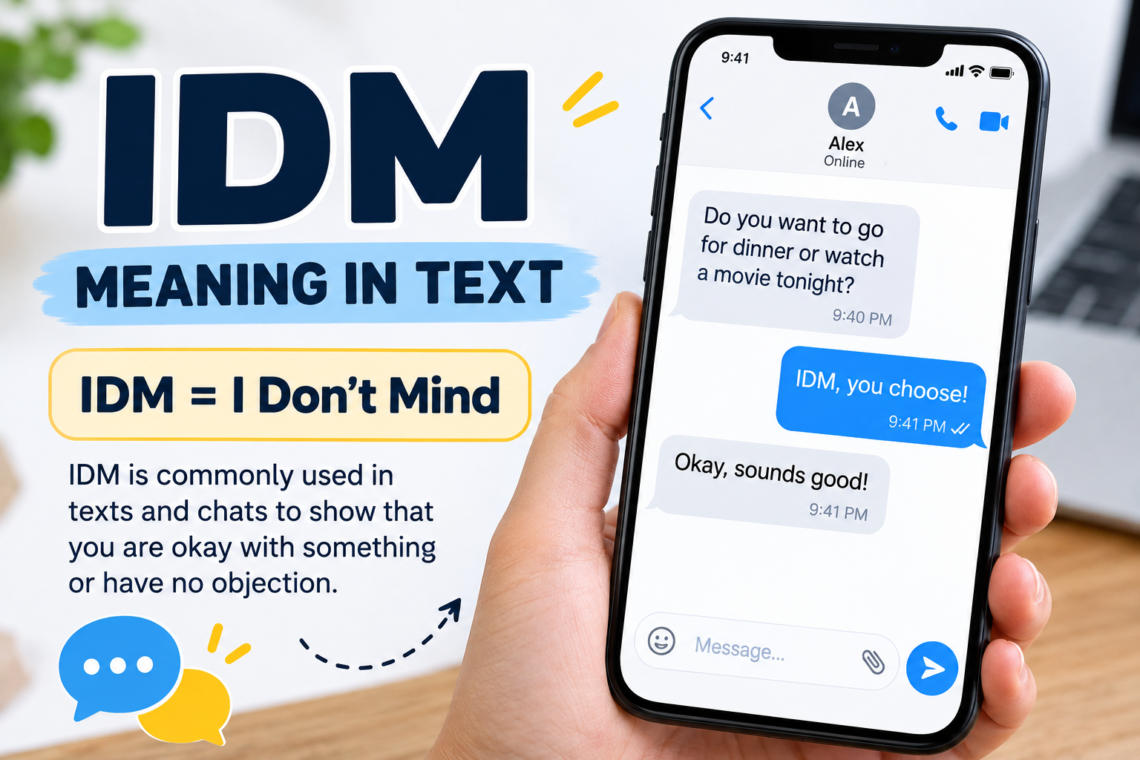
IDM meaning in text is most commonly understood as “I don’t mind.” It is a compact expression that appears in chats, social media conversations, comments, and casual messages when someone wants to show that they have no objection or preference. Although only three letters long, the phrase can carry different emotional shades depending on the conversation around it. Sometimes it sounds relaxed and accommodating; at other times, it can seem neutral or even slightly distant. Understanding the surrounding context is therefore essential when interpreting it correctly.
Why Three Letters Can Carry So Much Meaning
Digital communication has changed the way people express themselves. Instead of writing complete sentences, users often rely on abbreviations that save time while preserving the basic meaning of a message. In this environment, IDM fits naturally into fast-moving conversations. Someone might use it when choosing a restaurant, deciding what movie to watch, or responding to a simple suggestion. Consequently, the abbreviation often communicates flexibility rather than enthusiasm. The meaning is straightforward, but the emotional tone depends heavily on punctuation, previous messages, and the relationship between the people communicating.
IDM Usually Means “I Don’t Mind”
When someone writes IDM in a text message, the safest interpretation is generally “I don’t mind.” In practical terms, it means the person is comfortable with the available choices or does not strongly prefer one option. For example, if a friend asks whether you want to meet in the afternoon or evening, an IDM response suggests that either option is acceptable. However, it does not necessarily mean the person is excited about both choices. Instead, it usually signals openness, neutrality, or a willingness to let someone else decide.
The Difference Between Indifference and Flexibility
One interesting aspect of IDM is that it can represent either genuine flexibility or simple indifference. Context makes the difference. If a friend says, “We can watch a comedy or an adventure movie,” an IDM response may mean they are happy with either. On the other hand, a very brief reply after a long discussion might sound less enthusiastic. Therefore, readers should avoid interpreting the abbreviation in isolation. The surrounding conversation often provides important clues about whether the speaker feels relaxed, accommodating, uninterested, or simply unsure.
How Tone Changes the Message
Written communication lacks many of the signals found in face-to-face conversation, including facial expressions, gestures, and vocal emphasis. As a result, short abbreviations can sometimes create uncertainty. “IDM” on its own may appear completely neutral, while “IDM, you choose” sounds more cooperative. Similarly, adding an emoji or a friendly follow-up can make the message warmer. Conversely, a short response with no additional context may feel abrupt. Thus, understanding digital language requires more than translating an acronym; it requires paying attention to tone and conversational circumstances.
Where You Might See IDM in Everyday Chats
The abbreviation appears most naturally in informal digital spaces. Friends may use it while making plans, discussing food, selecting entertainment, or deciding where to go. It can also appear in group chats when participants want to avoid slowing down a decision. For example, if several people are choosing between two meeting places, someone might use IDM to indicate that either location works. Because of this practical function, the expression has become part of the broader culture of efficient online communication, where convenience often matters as much as complete sentences.
IDM and the Culture of Short-Form Communication
The popularity of abbreviations reflects a larger transformation in language. Texting encourages speed, and users have developed a shared vocabulary that allows complicated social interactions to happen with remarkably few characters. Terms such as LOL, BRB, IMO, and IDM belong to this wider linguistic culture. Nevertheless, these expressions are not merely shortcuts. They also create a sense of familiarity between people who understand the conventions. In that sense, digital abbreviations demonstrate how language continually adapts to new technologies and changing patterns of human interaction.
When IDM Could Be Misunderstood
Although IDM generally means “I don’t mind,” context remains important because abbreviations can occasionally be interpreted differently. A person unfamiliar with texting terminology may not recognize the expression at all. Furthermore, some acronyms have multiple meanings across different communities, industries, or platforms. Therefore, when clarity matters, writing the full phrase is often better than relying on three letters. This is especially true in professional communication, formal emails, academic settings, or conversations involving people who may not regularly use internet slang.
Is IDM Appropriate in Professional Messages?
Usually, IDM is better suited to casual communication than formal writing. Among close friends or familiar colleagues, it may be perfectly understandable. However, professional communication benefits from clearer and more conventional wording. Instead of using an abbreviation, a person could write “I don’t mind,” “Either option works for me,” or “I’m comfortable with either choice.” These alternatives remove ambiguity and create a more polished impression. Ultimately, choosing between an acronym and a complete phrase depends on the audience, the platform, and the level of formality expected.
A Simple Guide to Reading the Expression
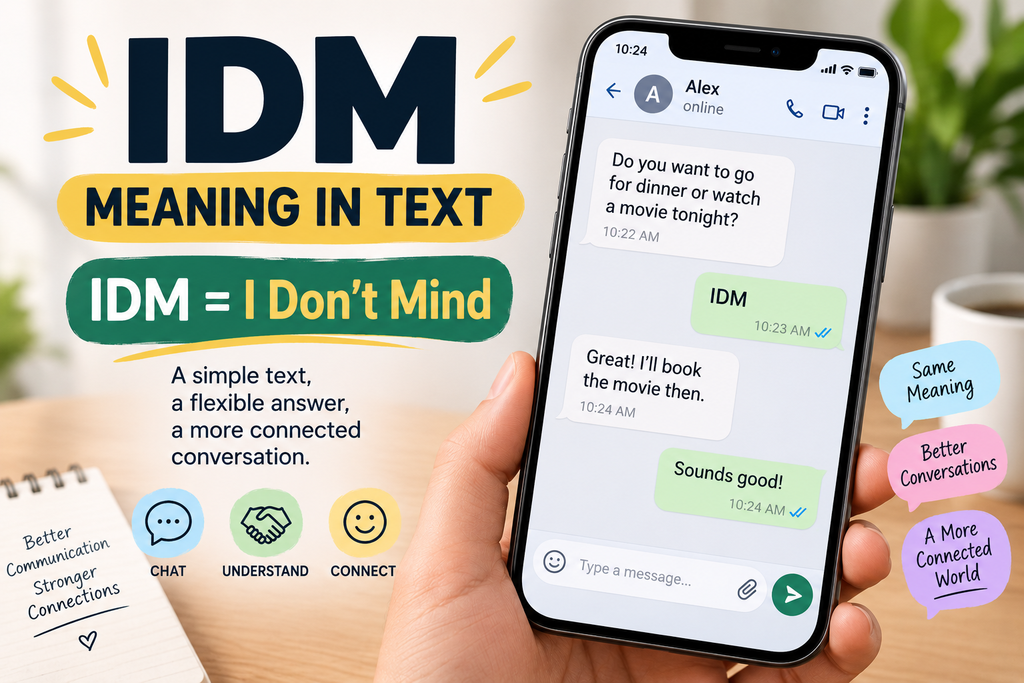
The easiest way to understand IDM is to look at what question came immediately before it. If someone asks, “Do you want pizza or burgers?” the answer generally communicates that either choice is acceptable. If someone asks, “Do you mind if I change the plan?” the same expression can indicate that the change is acceptable. In both cases, the central idea remains the same: the speaker does not object. However, the emotional meaning can range from genuinely easygoing to completely neutral, depending on the conversation.
Why Context Matters More Than the Acronym
Modern texting has created a fascinating situation in which very small expressions can depend on surprisingly large amounts of context. The letters themselves provide only a basic meaning, while the conversation supplies the emotional interpretation. A friendly exchange can make the abbreviation sound relaxed and cooperative. A tense conversation can make exactly the same response appear dismissive. Therefore, anyone trying to interpret digital language should consider the entire interaction rather than focusing on one isolated message. This approach produces a much more accurate understanding of what the sender intended.
Common Questions About IDM
What does IDM mean in texting?
IDM generally means “I don’t mind.” It tells the other person that the speaker has no strong objection or preference.
Is IDM rude?
Not necessarily. The abbreviation is normally neutral or casual. However, because it is short, some readers may interpret it as uninterested depending on the conversation.
Can IDM mean something else?
Yes. Acronyms can have different meanings in different communities. However, in ordinary texting, “I don’t mind” is the most common interpretation.
Should I use IDM in professional communication?
It is usually better to write the complete phrase in formal situations. This makes your message clearer and avoids unnecessary ambiguity.
The Quiet Power of Everyday Digital Language
Ultimately, IDM meaning in text illustrates something larger than a simple internet abbreviation. It shows how language evolves when people communicate through screens, keyboards, and increasingly rapid conversations. Three letters can express agreement, flexibility, or neutrality without requiring a full sentence. At the same time, the expression reminds us that digital communication is never entirely about words. Tone, timing, relationships, and context all shape meaning. In a world where conversations are becoming shorter and faster, understanding these subtle signals has become an important part of modern communication.