Introduction
WYO meaning in text is usually connected to a simple question: “What are you on?” In casual digital conversations, however, the abbreviation can take on a slightly different feel depending on the people talking, the platform, and the surrounding message. Like many internet expressions, WYO is less about formal grammar and more about speed, familiarity, and conversational rhythm. Understanding it therefore requires more than expanding three letters. It means looking at how people use short forms to keep conversations relaxed, spontaneous, and connected in an increasingly text-centered culture.
What WYO Usually Means in a Text Conversation
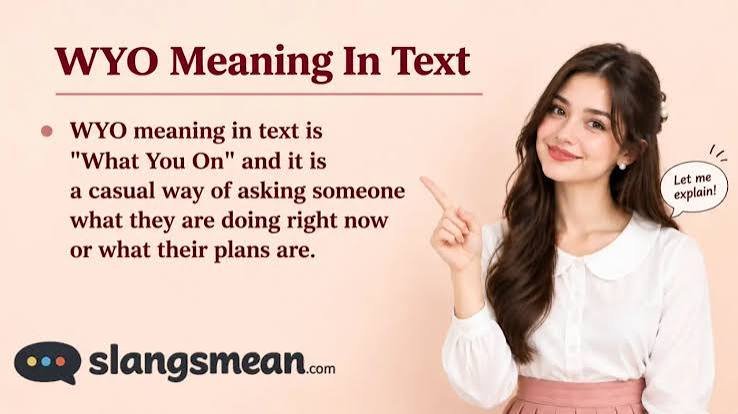
WYO commonly stands for “What you on?” or, depending on context, “What are you on?” It is generally used to ask what someone is doing, what they are up to, or what plans they have. For example, a friend might send the abbreviation when they want to start a conversation without writing a complete sentence. Consequently, its meaning is often close to “What are you doing?” or “What’s going on with you?” The exact interpretation comes from the surrounding conversation rather than the letters alone.
Why Three Letters Can Replace a Whole Question
Digital communication has created an environment where brevity matters. People often type while walking, studying, commuting, gaming, or moving between different activities. Therefore, abbreviations such as WYO offer a convenient shortcut without necessarily losing the conversational purpose of the message. Unlike formal writing, texting is designed around immediacy. A short expression can feel more natural than a carefully constructed sentence, particularly between friends who already understand each other’s communication style.
The Social Tone Behind the Abbreviation
The tone of WYO is usually casual and conversational. It can function as a friendly opener, a quick check-in, or an invitation to continue talking. For instance, someone who has not spoken to a friend for several hours might use it simply to ask what the other person is doing. Meanwhile, the same abbreviation in a group chat may signal an interest in plans or activities. Because tone is difficult to communicate through plain text, context remains important when interpreting short internet expressions.
WYO Meaning in Text Depends on Context
Although WYO has a common interpretation, abbreviations can occasionally develop different meanings within specific communities. A gaming group, social-media community, or private friend group may use the same letters differently. Furthermore, punctuation and neighboring words can change the intended feeling. “WYO?” is likely a direct question, while the abbreviation appearing alongside other casual slang may feel more playful. Readers should therefore avoid treating every three-letter acronym as having one universal definition.
How People Naturally Use WYO
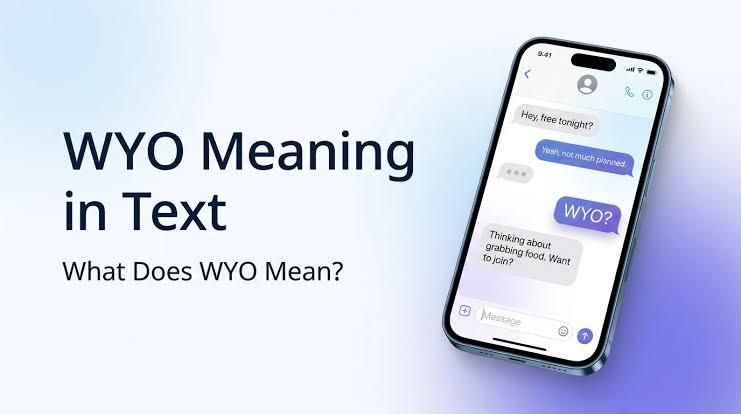
The expression works especially well when someone wants a quick response. Consider a conversation in which two friends are deciding whether to meet later. One person might use WYO to discover whether the other has plans. Similarly, it can appear when somebody wants to restart a conversation after a period of silence. Its usefulness comes from its openness: the recipient can respond with information about their current activity, plans, location, or general situation without following a rigid format.
A Look at WYO in Modern Digital Culture
Texting has gradually transformed the way people think about language. Earlier generations often viewed abbreviations as informal shortcuts, while younger digital communities have made them an ordinary part of everyday communication. As a result, expressions such as WYO exist alongside emojis, reaction images, shortened spellings, and other forms of digital shorthand. These expressions are not necessarily replacing traditional language. Instead, they demonstrate how language adapts when communication becomes faster, more mobile, and more dependent on small screens.
Similar Expressions You May Encounter
Understanding WYO becomes easier when it is compared with other casual texting expressions. “WYD” generally asks what someone is doing, while “WBU” means “What about you?” and “HBU” has a similar function. “WYA” commonly asks where someone is. These abbreviations overlap in everyday conversation, yet they are not interchangeable in every situation. Consequently, paying attention to the specific wording can help readers understand whether someone is asking about an activity, location, opinion, or reciprocal response.
| Text expression | Common meaning | Typical conversational purpose |
|---|---|---|
| WYO | What you on? / What are you on? | Asking what someone is doing or up to |
| WYD | What you doing? | Asking about a current activity |
| WYA | Where you at? | Asking someone’s location |
| WBU | What about you? | Returning a question |
| HBU | How about you? | Asking for the other person’s response |
Why Context Matters More Than the Dictionary
Internet slang does not always behave like traditional vocabulary. A dictionary can provide a definition, but a conversation provides the social meaning. Someone may use WYO as a genuine question, while another person might use it simply as an easy way to reopen a chat. Similarly, a close friend can understand an abbreviation that might confuse someone unfamiliar with the group. Thus, digital literacy involves recognizing not only words but also relationships, tone, timing, and shared communication habits.
Is WYO Appropriate Everywhere?
WYO is primarily suited to informal communication. It can work naturally in messages between friends, casual social-media conversations, and relaxed group chats. However, it would generally be unsuitable for formal emails, academic assignments, professional reports, or official correspondence. In those environments, writing “What are you doing?” or “What are your plans?” is clearer and more appropriate. The distinction illustrates a broader principle of modern language: effective communication depends not only on what is said, but also on where, why, and to whom it is said.
The Human Side of Digital Shortcuts
At first glance, WYO may seem like nothing more than three letters. Yet small expressions often reveal something about how people maintain relationships. A brief message can represent curiosity, friendliness, or an attempt to reconnect. Moreover, the simplicity of the abbreviation lowers the effort required to begin a conversation. In a world where people frequently communicate across busy schedules, these tiny linguistic shortcuts can make social interaction feel easier and more immediate.
Frequently Asked Questions
What does WYO mean in text?
WYO commonly means “What you on?” or “What are you on?” In everyday texting, it is generally used to ask what someone is doing, what they are up to, or what plans they have.
Is WYO the same as WYD?
Not exactly. WYD most directly means “What you doing?” while WYO can be used more broadly to ask what someone is up to. Their meanings can overlap considerably in casual conversations.
Can WYO have another meaning?
Yes. Internet abbreviations can have different meanings within particular communities or conversations. Context is therefore important before assuming a single interpretation.
Is WYO formal language?
No. WYO belongs primarily to casual digital communication. It is better suited to informal chats than professional, academic, or official writing.
Why do people use WYO instead of a complete sentence?
Speed and convenience are major reasons. Texting encourages concise communication, and familiar abbreviations allow people to communicate quickly while maintaining an informal conversational tone.
Conclusion
WYO meaning in text illustrates how modern communication continues to evolve through everyday use. What looks like a simple abbreviation can carry questions about activity, plans, friendship, and social connection. More importantly, its meaning is shaped by context rather than by the letters alone. As digital conversations become increasingly central to everyday life, expressions such as WYO show how language can become shorter without necessarily becoming less meaningful. The abbreviation is ultimately a small example of a much larger cultural shift: people continually reshape language to fit the way they live, connect, and communicate.